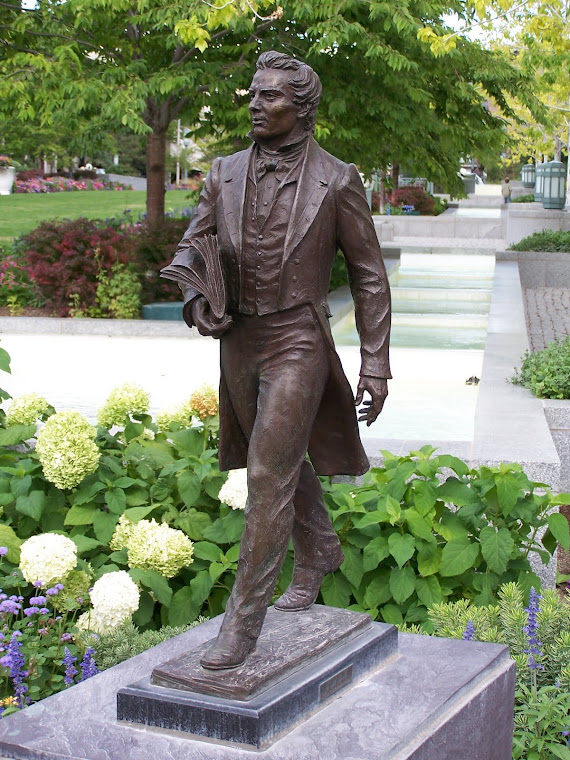
Joseph Smith

Joseph Smith
Prophet, Seer and Revelator

Monday, May 13, 2013

Kids love Burned Cricket Paste--the Story, not the Food.


I love to do Primary Sharing Time and Activity Days. This is one of the stories the kids love to hear. 

The first winter the Saints were in the Salt Lake Valley, food was precious and scarce. The Indians brought John Taylor a sweet meal. The dark paste crunched when he ate it and tasted like honey.

John asked the Indians how to make it. He knew his children would enjoy the extra sweet delicacy. The braves led John to a field where the wheat had been harvested. Only the dried stocks were left.  Crickets were feeding on the wheat kernels that had fallen to the ground.

The Indians took dead pine branches, broke off several sticks, and started them on fire. They lit the wheat stubble into a blaze all around the edges field. As the plants burned toward the center, hundreds of crickets jumped up out of the fire and fell back into it, burning to a crisp.

When the fire died out, the Indians took their baskets and scooped up the dead insects.

“Why are you gathering dead crickets?” asked John.

“Good food,” said an Indian.

The Indian women ground the charred remains into a fine power and mixed it with honey.

By the time I've told this much of the story and girls are gagging and the boys are shuddering. They love the grossness of this tale. However, they are willing to think about how hungry they would have to be to eat this paste.

It’s a great lesson to help all of us remember the sacrifice the pioneers made to settle in the valleys of the mountains and make it a beautiful place for us to live.

Saturday, April 27, 2013

John Taylor's Courage to Rip his shirt open


After John Taylor’s conversion to the gospel, he traveled from Canada to Kirtland to meet the prophet Joseph Smith. On his return to trip, he encountered a group of people outside Columbus, Ohio, who asked him to speak to them.
People gathered around on the hillside to listen. As John stood on a wagon tongue to speak about the religious principles of his new found Mormonism, he could see men with tar and feathers lurking in the back of the congregation.
John began to speak, “Gentlemen, I know your forefathers fought for the freedom of all men in this country during the American Revolution. Many of them died for our freedom.”
 John paused momentarily, and then his voice rose in strength. “I understand you plan to tar and feather me for preaching. Is this the reason your father’s died in that great war—so you would have the right to tar and feather someone?”
John stood straight and tall. “Come on with your tar and feathers, gentlemen. I am ready.”
A hush came over the people, and every eye was on John.

He grabbed hold of his vest and shirt and ripped them open, ready for the tar and feathers. The buttons popped off and fell to the ground. Everyone stood very still—not moving or saying a word.

Saturday, April 20, 2013

Missionary Courage


As John Taylor stood on the bow of the ship, sailing from Liverpool to America, waves crashed all around him. Lightening flashed across the sky. The boat rocked sideways. Salt spray spewed his face.  He shivered under the cold wetness.  Licking the salt from his lips, he declared: “I feel as calm as though I were sitting in the parlor at home.” He knew he would reach America.

Thursday, April 4, 2013

Early Saints and Temple Work


Temple work meant so much to the early Saints. I love to read their journals and quotes because it helps me remember to keep sacred covenants foremost in my mind and never take the blessings of the temple for granted.

Saturday, March 30, 2013

Escape from the French Police


John spoke in many churches in France and debated with ministers as he’d done in England. Some people joined to the Church, but most of the French citizens were too worried about political unrest to think of religion. Napoleon’s nephew, Louis Napoleon, was elected president. He then took over the army, suppressed the newspapers, and had the senate make him the Emperor – a revolution was in the making.
John worked hard for two years in France and Germany. When he knew the time for his mission was drawing to a close, he wanted to meet with the Saints in Paris to say farewell. He loved them and wanted to bear his testimony of the truthfulness of the gospel to them one last time.
The authorities had forbidden John to preach in Paris, but that didn’t stop him. He called for a conference of the members. Brother Bolton told him it was too dangerous.
John decided to hold the meeting on the day Louis Napoleon was to become president. The soldiers in Paris were busy with the election so no one noticed the Mormons. About four hundred Saints attended the conference. John organized a presidency for the area so that the work could go on without him. He planned to leave for England the following day.
            By the next morning, the authorities had heard about the conference and came to arrest John. His train was to leave in the afternoon, but the Spirit told him to get away as soon as he could. He said good-bye to his landlord and slipped out the back door to catch a cab. Just a few minutes later, the police knocked at the door looking for John. He learned later in a letter that his landlord had invited the officers in and the landlord’s sister-in-law served tea. The landlord and his sister charmed the officers, but soon the police realized what had happened. By then John was on his way to England and safety.5

Tuesday, March 19, 2013

Wouldn't it be nice if God did our work for us?


Wouldn’t it be nice if God did our work for us?
As Brigham Young and the first pioneer company prepared to cross the Platte River, he could see that the water was running high. 

Friday, March 15, 2013

The Enabling Power of the Atonement


The enabling power of the Atonement strengthens us to do good and serve beyond our own natural capacity. David A. Bednar.
As I read this quote the other day, I thought of Brigham Young. He lived his boyhood in upstate New York. He had a pair of shoes for Sunday, but that’s all. He cleared the heavily vegetated land, barefoot, one bush at a time.