John continued to publish the Times and Seasons newspaper and equip his family for the trek west.
It was February of 1846, and John and his family were ready to leave. All the arrangements had been made – food gathered, wagons outfitted. John and his family drove down Parley Street for the last time. Leaving behind their beloved City of Nauvoo, they headed toward the Mississippi and a new life in the west. John glanced back with a heavy heart. He had walked away from a two-story brick house, with a store next to it. On the other side of his house was a new printing office he had helped build. Together the lot and buildings were worth about $10,000. He also left a 106 acre farm on the outskirts of town, along with another city lot. For the sake of the gospel, he could start again.
It was sad to leave all he had built. He left his whole life for the gospel's sake.
Joseph Smith
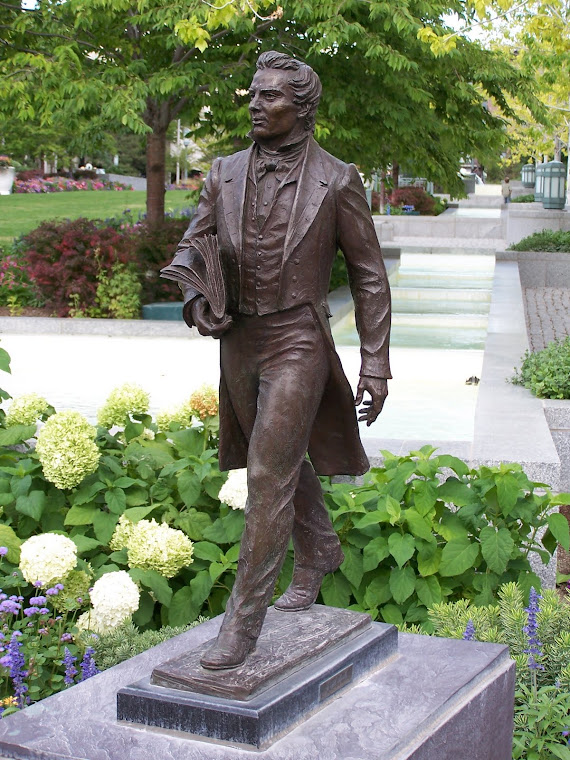
Prophet, Seer and Revelator
Friday, October 19, 2012

Friday, October 12, 2012
Establishing a Home in the West
How oft when they [Saints] have met together . . . has the spirit of revelation rested upon them, and the future been opened to their view in all its beauty.
Joseph, the Prophet, and his brother Hyrum were dead. Chaos reigned in the State of Illinois. Anti-Mormons called for the extermination of the Saints from the area. False accusations about the Saints hung over Nauvoo like an impending storm. Several groups sprang up, trying to usurp the leadership of the Church. Sidney Rigdon wanted to call himself the ‘guardian’ of the Church. Brigham Young addressed the Saints, telling them that the Twelve Apostles should lead the Church. After much preaching and discussion, and through prayerful consideration, the Saints voted to follow the Twelve.
Because of the constant persecution, the Saints knew they would be forced to leave Nauvoo for the west. Even as they built their wagons and packed their supplies, they continued to work on the temple. John worried the Saints would be unable to finish it before being driven from the state. On June 18, 1845 he wrote in his journal, “I dreamt that I stood by the temple and . . . saw that it was finished . . . and rejoiced.” This dream answered John’s prayers and relieved his fears about the temple. Heavenly Father would help them complete it. As soon as the building could be occupied, the Twelve worked day and night to give everyone an opportunity to receive the temple blessings that had been revealed to Joseph Smith. The Saints were eager for these gifts from God, and gratitude filled their hearts as they received this endowment from on high.
Saturday, October 6, 2012
Eliza R. Snow wrote of John:
To Elder John Taylor
Thou Chieftain of Zion! Henceforward thy name
Will be class’d with the martyrs and share in their fame;
Thro-ages eternal, of thee will be said,
With the greatest of prophets he suffer’d and bled.14
John experienced trials in Nauvoo – including the murder of his dear friend and leader, the Prophet Joseph, yet he never lost faith. Through the strength of his testimony, he always sided with the truth, working for righteousness.
With faith John bore his trials
Saturday, September 29, 2012
As John slowly recovered, he wrote of his friendship for the Prophet in poetry:
“The Seer, the Seer, Joseph the Seer!
I’ll sing of the Prophet ever dear;
His equal now cannot be found,
By searching the wide world around,
With Gods, he soared in the realms of day,
And men he taught the heavenly way.
The earthly Seer! The heavenly Seer!
I love to dwell on his memory dear;”
The Saints were grief-stricken. Confusion reigned. What would happen to the Church? Brigham Young would become their leader, but John was the last connection they had to the Prophet Joseph and the Saints revered him for it. Wilford Woodruff recorded this revelation in his journal: “While I [Heavenly Father] have taken my servants Joseph and Hyrum Smith unto myself, I have preserved my servant John Taylor for a wise purpose in me.”
Monday, September 24, 2012
John was so glad to be back in Nauvoo with the Saints. “I shall never forget the feelings of gratitude that I then experienced towards my Heavenly Father . . . the Lord had preserved me by a special act of mercy . . . I had still a work to perform upon the earth.”10
“I rejoice in afflictions; . . . and I rejoice when I triumph over them, because God answers my prayers.”11 As a living martyr, John was with Joseph Smith during his last minutes on this earth.
John recorded the martyrdom of Joseph Smith and Hyrum in the Doctrine and Covenants, Section 135: “To seal the testimony of this book and the Book of Mormon, we announce the martyrdom of Joseph Smith the Prophet, and Hyrum Smith the Patriarch. . . . Joseph . . . has done more, save Jesus only, for the salvation of men in this world, than any other man that ever lived in it. . . . In life they [Joseph and Hyrum] were not divided, and in death they were not separated. . . . They lived for glory; they died for glory; and glory is their eternal reward.”
The spiritual strength of the poetic language of this scripture is felt in the hearts of people throughout the world. Many Saints know the verses by heart. Through the Spirit, the truthfulness of the message John recorded can be felt by all nations.
Saturday, September 8, 2012
Leonora came that afternoon and brought Dr. Samuel Bennet to remove the ball in John’s hip. John wanted no whiskey as an anesthetic. He would bear the pain. In fact the cutting was a relief to the agony he suffered. The bullet near his knee remained the rest of his life.
Because of his wounds and loss of blood, John remained in Carthage for several days, unable to return to Nauvoo in a carriage or wagon. The pain would be too great. But he longed to return home. Carthage seemed a dangerous place. Would a mob kill him also?
The Saints didn’t attack Carthage so the people came back to their homes. They thought about keeping John as a hostage. If he was in Carthage, the Saints wouldn’t retaliate.
But John wanted to go home. Several men hooked a sleigh to the back of a wagon and laid John carefully on it. Sliding across the prairie grass with Leonora at his side filled him with thankfulness. He would be back with the people he loved.
Saturday, September 1, 2012
Willard Richards, who was unharmed, dragged John into the next room and threw a dirty straw mattress over him, hoping to protect him.
John coughed at the dusty mattress covering him. What had just happened? Joseph’s body lay in the yard. Hyrum’s body rested peacefully in the next room. Pain wracked John’s knee and hip. His hand ached. Grief overwhelmed him.
The Prophet was dead. “I felt a dull lonely sickening sensation at the news. . . We [the Saints] were left alone.” How would the Church continue without Joseph? Was all lost?
The people of Carthage feared the Saints would retaliate. They fled their city. A few curious onlookers stayed behind, climbing the stairs of the jail to see the damage. One of them was a doctor. With no pain medication, he gouged the bullet out of John’s hand with a dull pen knife. John later called it “surgical butchery.”
Some of the people tried to move him to the Hamilton Hotel where he could be cared for, but he would not go. He feared for his life. After eight hours of anguish, he allowed himself to be moved. It was two in the morning. Colonel Jones of the Hancock County militia was kind to him. He stayed with John to protect him. When he had to leave John’s room, he left two loaded pistols on the table for him.
Subscribe to:
Posts (Atom)