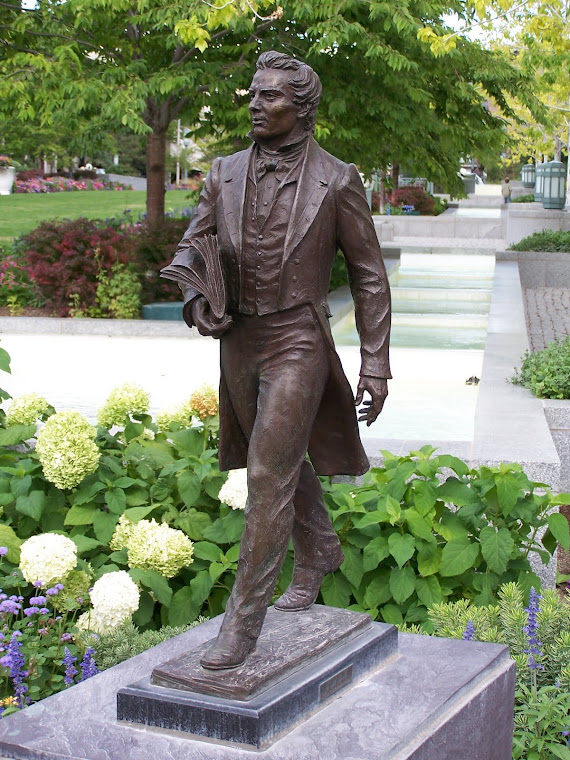
Joseph Smith

Joseph Smith
Prophet, Seer and Revelator

Saturday, March 9, 2013

A Missionary in France


The ocean voyage to France seemed to last forever, but it was uneventful. During the trip John practiced his French so when he got to Boulogne-sur-Mer he was able to greet the mayor in halting, but understandable French. The mayor was charmed that John spoke to him in his native tongue and replied in broken English. He gave John permission to preach in the city. That night John and Elders Bolton and Pack walked along the sea shore and thanked the Lord for preserving them, dedicating themselves to His service.4
            While John was in France, he organized several branches of the Church, including one in Paris, oversaw the translation of the Book of Mormon into French, and established a Mormon newspaper, The Star of Deseret. Next john traveled to Germans where he spent time organizing the translation of the Book of Mormon into German and started a newspaper called Zion’s Banner.
r horse- � r w @n �[o ws and cocked their rifles as if to shoot. With a prayer in their hearts and faith in the Lord, the missionaries stood firm.
            Soon the chief urged his horse forward. He handed the missionaries a letter saying the Indians were peaceful members of the Cheyenne tribe. John shifted in his saddle, wiping the sweat from his forehead and offering a silent prayer of gratitude for safety.
The missionaries invited the Indians to feast with them on dried meat and crackers. That evening John and a few of the others visited the Indians’ camp. The tribe seemed friendly but a little embarrassed because their plan to frighten the group hadn’t worked.2

Saturday, March 2, 2013

War Paint


When the brethren crossed the Platte River, they rested their horses. Distant thunder shook the ground, and alarm crept into their hearts. Riders on horseback galloped over the horizon. The only sound that could be heard was the drumming of hooves on the hard ground, dusting the earth behind them. As they rushed closer, John could see they were Indians dressed in war paint and feathers – their bows and rifles in hand.
            With the river in back of them, the missionaries had no place to hide or time to escape. They couldn’t outrun the Indians. John knew he and the other travelers were in the hands of the Lord. He prayed.
The missionaries froze in place, knowing they could die at any moment. They waited. The Indians thundered closer. Were they on the war-path or friendly? They weren’t yelling any war whoops.
When the Indians got within a few feet of the missionaries, they reined in their horses, drew their bows and cocked their rifles as if to shoot. With a prayer in their hearts and faith in the Lord, the missionaries stood firm.
            Soon the chief urged his horse forward. He handed the missionaries a letter saying the Indians were peaceful members of the Cheyenne tribe. John shifted in his saddle, wiping the sweat from his forehead and offering a silent prayer of gratitude for safety.
The missionaries invited the Indians to feast with them on dried meat and crackers. That evening John and a few of the others visited the Indians’ camp. The tribe seemed friendly but a little embarrassed because their plan to frighten the group hadn’t worked.

Friday, February 22, 2013

John Taylor, Missionary


I rejoice in proclaiming this glorious gospel, because it takes root in the hearts of the children of men, and they rejoice . . . in the blessings of the Kingdom of God.1

            At the October conference of 1849 Brigham Young called John on a mission to France along with Elders Bolton and Pack. Leaving the Salt Lake Valley with them were Lorenzo Snow, going to Italy; Erastus Snow, traveling to Denmark; Franklin D. Richards on his way to England and others who would preach in the Eastern States.
            As they crossed the plains, the brethren scanned the horizon, looking for Indians. They met a group of men carrying mail who told them they’d been attacked by Indians and robbed (or ‘tithed’ as John called it) of supplies, including blankets and clothing. The missionary party grew anxious and searched the landscape for signs of war paint and horses. 

Saturday, February 9, 2013


John also built the first boat to sail on Utah Lake. He used a net that his wives made to catch fish – a tasty change from tough beef through the long winter.13
The next summer crickets came in hoards thick as black clouds, devouring the sparse crops of the Saints. John prayed, along with everyone else, for a miracle. The seagulls came and stuffed themselves with crickets and spewed them out in the Great Salt Lake – over and over again. A miracle!
The life of the pioneers was hard. John worked alongside the Saints to turn discouragement into hope. His trust in God blessed others because they leaned on his faith until their own became strong. Because of John’s unwavering testimony and faith, the Saints loved him. 

Friday, February 1, 2013

Burned Cricket Paste. Yuck!


Brother George Bean came to visit John with an old Goshute Indian who called himself a medicine man. The Indian told John that many of his tribe were dying of the white man’s disease of measles. He asked for a blessing for Yellow Bird, the twelve-year-old son of Chief Little Face. John and Brother Bean went with the medicine man and blessed Yellow Bird. The boy recovered.
The grateful Indians brought gifts of moccasins and gloves along with sego lily and camus bulbs, thistle roots, sunflower seeds, pine nuts, and wild honey. The Indians told John where to gather more. John’s prayers were answered. There was also a bag of meal that his family liked. John wanted to know how to make it, and the Indians showed him. They encircled a field with fire and burned the brush along with lots and lots of crickets. As the crickets roasted in the fire, the Indians gathered them and then ground them up, mixing them with honey for a delectable meal that could be made into cakes.
This is not delectable meal in my book!

http://www.deseretnews.com/article/865568837/Book-review-Texting-through-Time-John-Taylor-and-the-Mystery-Puzzle-will-delight-young-readers.html

Sunday, January 13, 2013

The Trek West


Under the direction of Brigham Young, the apostles who remained in Winter Quarters prepared the first pioneer company to leave for the West in the spring of 1847. Upon returning from England, John and Parley P. Pratt were to organize a second company to come west that same summer. They began their trek in June with six hundred wagons, 1,553 pioneers, 2,213 oxen, 887 cows, 358 sheep, 716 chickens and quite a few pigs. The group was divided into six sections of one hundred wagons each.11
This second pioneer company that John and Brother Pratt were in charge of reached the Salt Lake Valley on October 5th. By Christmas John had built housing, barns, and corrals and laid out a garden spot. The Saints had very little to eat that winter besides corn meal, flour, and tough beef. They needed better nourishment. John prayed that he would know how to find more food for his family. 

Saturday, January 5, 2013

Horse and Hide


About this same time news came from England that the men who were to collect passage for the poor British Saints to come to America had squandered all the money. Brigham Young asked John, Parley P. Pratt and Orson Hyde to go to England to solve the problem.
Before he left, John made arrangements for his family to be taken care of until he could return. He would never forget how ill Leonora had been when he came back from his last mission.
When John arrived in Great Britain, one of the offenders fled to London; and the other men were severely reprimanded. John visited the Saints throughout the land and restored confidence in the Church. The people welcomed him with open arms, and the Saints in Wales gave him an ovation.8
John and Orson Hyde published the Millennial Star while in England. John had a wonderful sense of humor and there were times when he and Brother Hyde had a good laugh as they collected money for the paper. John knew that at times the British dropped or added an ‘h’ to a word, so he was not surprised when they had difficulty understanding how to spell ‘Orson Hyde.’ John and Brother Hyde ran a small notice in the Millennial Star, stating that some orders for the paper came addressed to “Horse and Hide,” or Horson Ide.” ‘Orson Hyde’ was spelled correctly so everyone would know how to address their subscriptions.9