As John slowly recovered, he wrote of his friendship for the Prophet in poetry:
“The Seer, the Seer, Joseph the Seer!
I’ll sing of the Prophet ever dear;
His equal now cannot be found,
By searching the wide world around,
With Gods, he soared in the realms of day,
And men he taught the heavenly way.
The earthly Seer! The heavenly Seer!
I love to dwell on his memory dear;”
The Saints were grief-stricken. Confusion reigned. What would happen to the Church? Brigham Young would become their leader, but John was the last connection they had to the Prophet Joseph and the Saints revered him for it. Wilford Woodruff recorded this revelation in his journal: “While I [Heavenly Father] have taken my servants Joseph and Hyrum Smith unto myself, I have preserved my servant John Taylor for a wise purpose in me.”
Joseph Smith
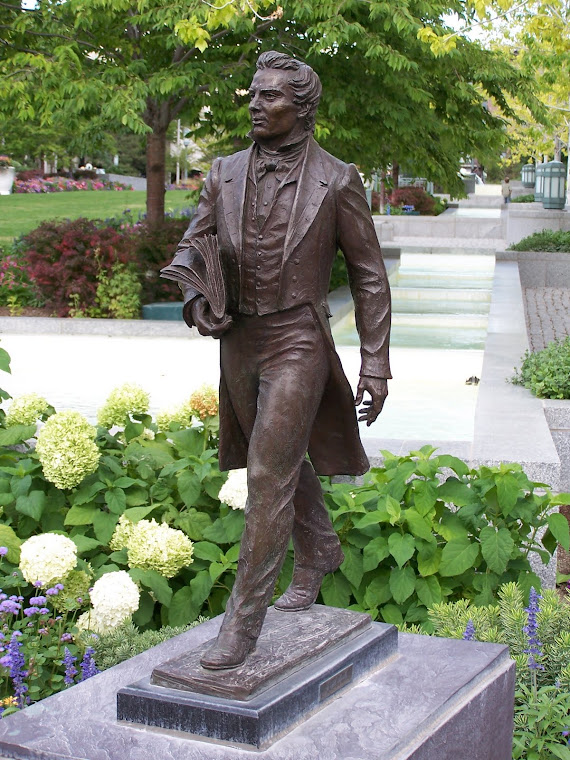
Prophet, Seer and Revelator
Saturday, September 29, 2012

Monday, September 24, 2012
John was so glad to be back in Nauvoo with the Saints. “I shall never forget the feelings of gratitude that I then experienced towards my Heavenly Father . . . the Lord had preserved me by a special act of mercy . . . I had still a work to perform upon the earth.”10
“I rejoice in afflictions; . . . and I rejoice when I triumph over them, because God answers my prayers.”11 As a living martyr, John was with Joseph Smith during his last minutes on this earth.
John recorded the martyrdom of Joseph Smith and Hyrum in the Doctrine and Covenants, Section 135: “To seal the testimony of this book and the Book of Mormon, we announce the martyrdom of Joseph Smith the Prophet, and Hyrum Smith the Patriarch. . . . Joseph . . . has done more, save Jesus only, for the salvation of men in this world, than any other man that ever lived in it. . . . In life they [Joseph and Hyrum] were not divided, and in death they were not separated. . . . They lived for glory; they died for glory; and glory is their eternal reward.”
The spiritual strength of the poetic language of this scripture is felt in the hearts of people throughout the world. Many Saints know the verses by heart. Through the Spirit, the truthfulness of the message John recorded can be felt by all nations.
Saturday, September 8, 2012
Leonora came that afternoon and brought Dr. Samuel Bennet to remove the ball in John’s hip. John wanted no whiskey as an anesthetic. He would bear the pain. In fact the cutting was a relief to the agony he suffered. The bullet near his knee remained the rest of his life.
Because of his wounds and loss of blood, John remained in Carthage for several days, unable to return to Nauvoo in a carriage or wagon. The pain would be too great. But he longed to return home. Carthage seemed a dangerous place. Would a mob kill him also?
The Saints didn’t attack Carthage so the people came back to their homes. They thought about keeping John as a hostage. If he was in Carthage, the Saints wouldn’t retaliate.
But John wanted to go home. Several men hooked a sleigh to the back of a wagon and laid John carefully on it. Sliding across the prairie grass with Leonora at his side filled him with thankfulness. He would be back with the people he loved.
Saturday, September 1, 2012
Willard Richards, who was unharmed, dragged John into the next room and threw a dirty straw mattress over him, hoping to protect him.
John coughed at the dusty mattress covering him. What had just happened? Joseph’s body lay in the yard. Hyrum’s body rested peacefully in the next room. Pain wracked John’s knee and hip. His hand ached. Grief overwhelmed him.
The Prophet was dead. “I felt a dull lonely sickening sensation at the news. . . We [the Saints] were left alone.” How would the Church continue without Joseph? Was all lost?
The people of Carthage feared the Saints would retaliate. They fled their city. A few curious onlookers stayed behind, climbing the stairs of the jail to see the damage. One of them was a doctor. With no pain medication, he gouged the bullet out of John’s hand with a dull pen knife. John later called it “surgical butchery.”
Some of the people tried to move him to the Hamilton Hotel where he could be cared for, but he would not go. He feared for his life. After eight hours of anguish, he allowed himself to be moved. It was two in the morning. Colonel Jones of the Hancock County militia was kind to him. He stayed with John to protect him. When he had to leave John’s room, he left two loaded pistols on the table for him.
Saturday, August 25, 2012
Angry cries broke the stillness. A mob with black axel-greased faces shouted obscenities, storming the jail. They fired through the door, killing Hyrum instantly. John rushed to hold the door shut. Crashing through the entry, the men smashed John against the wall and continued to fire their weapons. John fought back, deflecting the discharging guns with a cane as their muzzles came through the door.
“That’s right, Brother Taylor, parry them off as well as you can.” These were Joseph’s last words to John.
John ran for the open window, but a bullet struck his left leg near his knee. He fell onto the windowsill, hitting his pocket watch and throwing him back into the room. Bleeding, he dragged himself under the bed; bullets pierced his right thigh and his left hand.
The Prophet ran to the window. Did he do it to draw the gun fire away from his friends? Weapons fired on him from inside and outside the jail. Joseph Smith leaped from the window and was killed.
The mob left the jail, gathering outside.
Mobs sought to destroy the Church and thought that the best way would be to kill the Prophet. Angry men roamed the country, plotting the death of Joseph Smith. Fear filled the air.
Reluctantly, but of their own choice, Joseph and Hyrum Smith went to Carthage jail to be locked up. Irate groups gathered there, crying for the death of Joseph Smith. Governor Ford came to Carthage to try to smooth the situation. John met with the Governor on June 27, 1844, to see if he would protect Joseph and Hyrum, but the Governor felt the law should take its course. The hearing would be in two days. John felt helpless and frustrated.
On that same day John and Willard Richards waited with Joseph and Hyrum in Carthage Jail, looking toward the hearing on June 29. The afternoon felt muggy and oppressive. Heaviness weighed on John’s chest.
Hyrum asked John to sing “A Poor Wayfaring Man of Grief.” John sang – his rich, deep voice echoing through the prison with sadness lacing the melody.
“Sing it again,” Hyrum said.
John sighed. “Brother Hyrum, I do not feel like singing.”
“Oh, never mind; commence singing and you will get the spirit of it,” Hyrum replied.
John inhaled the sultry air and sang one more time, feeling an unexplained sorrow. The weight of the afternoon heat seemed unbearable.
Sunday, August 19, 2012
During the next few months opposition to the Church became bitter and angry. Harassment of the Mormons in Missouri had come from nonmembers of the Church, but much of the persecution in Nauvoo came from those who joined the Church and then had fallen away. Some of the apostates set up an anti-Mormon newspaper called the Nauvoo Expositor. On June 7, 1944 the paper cruelly derided the Prophet and the Saints in Nauvoo.
The city council met in long sessions to decide what to do. Should they demolish the newspaper? They studied city codes to see what legal action they could take, using a famous English judge and jurist of the time, William Blackstone, as an authority. The council decided that if a newspaper slandered people, it could be considered a public nuisance and should be destroyed. Twenty presses in the State of Illinois had been dismantled in the last twenty years for the same reasons without any retaliation. The council also felt, if they didn’t take action, angry Mormons would probably tear down the press anyway, causing more problems. The Nauvoo Expositor was demolished.
Anti-Mormon outrage at the destruction of a free press called for the Saints to be driven from Illinois. Joseph sent word to the men on political missions, campaigning for his presidency, to return home. He also wrote to Governor Ford of Illinois, asking for help; but the governor did nothing.
Mobs threatened to destroy Nauvoo if Joseph and Hyrum were not put in jail. Joseph and Hyrum said they would go to Carthage to protect Nauvoo and the Saints, but they felt they had done nothing wrong. A hearing date was set.
In the early part of the day on June 24, Joseph, Hyrum and John Taylor with others paused at the temple site on their way to Carthage. Joseph said, “This is the loveliest place and the best people under the heavens; little do they know the trials that await them.”
Subscribe to:
Posts (Atom)