Brigham wanted the young people of Utah to have the opportunity to learn as much as possible so he started several schools of higher education. In 1850 Brigham organized the University of Deseret, now the University of Utah. Under the direction of Karl G. Maeser, he established an academy in Provo in 1875, which is now Brigham Young University. In 1877 he began the Brigham Young College in Logan, to educate teachers for schools in settlements throughout the west. It later became Utah State University.
Education was important to Brigham Young, whether it was for his own children, the children of the community, the women of the Church, or establishing institutions of higher education. “My policy is to keep everybody busy in building up the Kingdom; [including] building academies and other places of learning.”
Joseph Smith
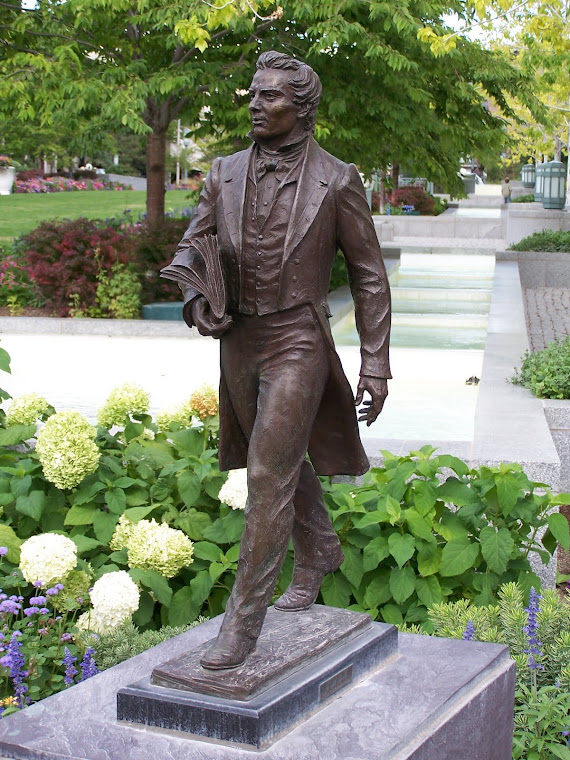
Prophet, Seer and Revelator
Showing posts with label Education. Show all posts
Showing posts with label Education. Show all posts
Saturday, May 14, 2011

Saturday, May 7, 2011
Brigham Young, Midwives
Since women often died in childbirth because of inadequate medical help, the need for midwives was critical. Brigham urged Romania B. Pratt, wife of Parley Pratt Jr., to go to New York to medical school so she could train midwives to work in the outlying communities. She left her husband and five children, including a small baby, to go east to school. After one year, she found that she did not have enough money to complete her education. So she returned home and asked Eliza R. Snow and the Relief Society to help her. Word went out to the women of the Church; and through many small donations of the sisters, she received enough money to finish her degree. She came back to Utah and taught others about medicine, midwifery, and nursing.
Saturday, April 30, 2011
Brigham Young, Educating Women
Brigham felt it was important to educate women as well as men. He wanted women to learn about whatever they were interested in. “We think the sisters ought to have the privilege to study various branches of knowledge . . . they may . . . study law and physic [medicine], or become good bookkeepers . . . In following these things they but answer the design of their creation.”8
Ellis Reynolds lived in Pleasant Grove, Utah with her family. Her mother died when she was fourteen; and after her father remarried, she stayed with her grandparents. On a visit to Salt Lake City, she met one of Brigham’s step sons and was introduced to the Young family. Brigham saw Ellis again when he visited Pleasant Grove. He was impressed with her intelligence and zest for life, and invited her to come live at the Beehive house and go to school with his children.
Two years later Ellis married Milford Shipp and began her family. Her thirst for knowledge was so strong that she arose every morning at four a.m. to study before her husband and children awoke. At the age of twenty-eight, she left for medical school in Philadelphia with the blessing of her husband and Brigham. She completed her education and returned to Utah to practice medicine.
Ellis Reynolds lived in Pleasant Grove, Utah with her family. Her mother died when she was fourteen; and after her father remarried, she stayed with her grandparents. On a visit to Salt Lake City, she met one of Brigham’s step sons and was introduced to the Young family. Brigham saw Ellis again when he visited Pleasant Grove. He was impressed with her intelligence and zest for life, and invited her to come live at the Beehive house and go to school with his children.
Two years later Ellis married Milford Shipp and began her family. Her thirst for knowledge was so strong that she arose every morning at four a.m. to study before her husband and children awoke. At the age of twenty-eight, she left for medical school in Philadelphia with the blessing of her husband and Brigham. She completed her education and returned to Utah to practice medicine.
Saturday, April 23, 2011
Brigham's Actions on Skipping School
Brigham had so many children of his own that he started a school for just his family. Don Carlos, Brigham’s son, cut school often because he loved to go with the men who drove Brigham’s wagons. When Brigham found out about it, he took Don Carlos to the barn and gave him a wagon hitched with two blind mules. Brigham told Don Carlos he could work hauling produce and ice around town, and bringing wood from the canyons.6 Guiding blind mules around the city was a difficult task, but Don Carlos was determined to succeed. He worked hard and accomplished the responsibilities given him.
Don Carlos soon became a good teamster, earning the right to drive the best team in the stables. At the age of twelve he was responsible enough to haul a load of wheat fifty miles north to Logan, Utah and back. However, he got tired of driving and was glad to get back to school.
Don Carlos graduated from the family school and then attended the University of Deseret in Salt Lake City. He went on to study in New York, obtaining a degree in engineering. He returned to Utah to pursue his interest in architecture. Being hired as Church architect, he was given the opportunity to redesign the towers of the Salt Lake Temple which were originally to be made out of wood covered with tin. He also designed the Church Administration Building on South Temple in Salt Lake, and the original Brigham Young University building in Provo.
Don Carlos soon became a good teamster, earning the right to drive the best team in the stables. At the age of twelve he was responsible enough to haul a load of wheat fifty miles north to Logan, Utah and back. However, he got tired of driving and was glad to get back to school.
Don Carlos graduated from the family school and then attended the University of Deseret in Salt Lake City. He went on to study in New York, obtaining a degree in engineering. He returned to Utah to pursue his interest in architecture. Being hired as Church architect, he was given the opportunity to redesign the towers of the Salt Lake Temple which were originally to be made out of wood covered with tin. He also designed the Church Administration Building on South Temple in Salt Lake, and the original Brigham Young University building in Provo.
Saturday, April 9, 2011
Brigham Young and Education
We might ask, when shall we cease to learn? I will give you my opinion about it: never, never.
Brigham Young
Before the pioneers came west, Brigham urged them to bring copies of books, maps, paper, pencils and other things that would be helpful in teaching children to read. So books and note pads were tucked into blankets in the wagon beds and brought west. At Brigham’s request, the Saints who sailed around South America brought with them a large library of school books.
The first school in the Salt Lake Valley opened in October of 1847, in an old military tent shaped like a wigwam erected in the middle of the fort. The teacher, Mary Jane Dilworth, sat on an old camp stool, and the students sat on logs. Some of the pupils brought slates to write on and others had paper and pencils. But a few wrote on smooth logs or dried bark with a piece of charcoal.
The first day of school, the teacher began with a prayer and then each pupil learned a psalm from the Bible. In the winter, schools were opened for adults. Several languages were taught, including Hebrew, Greek, and Latin. A series of classes cost $1.20 and an individual lecture was $0.20.
Brigham Young
Before the pioneers came west, Brigham urged them to bring copies of books, maps, paper, pencils and other things that would be helpful in teaching children to read. So books and note pads were tucked into blankets in the wagon beds and brought west. At Brigham’s request, the Saints who sailed around South America brought with them a large library of school books.
The first school in the Salt Lake Valley opened in October of 1847, in an old military tent shaped like a wigwam erected in the middle of the fort. The teacher, Mary Jane Dilworth, sat on an old camp stool, and the students sat on logs. Some of the pupils brought slates to write on and others had paper and pencils. But a few wrote on smooth logs or dried bark with a piece of charcoal.
The first day of school, the teacher began with a prayer and then each pupil learned a psalm from the Bible. In the winter, schools were opened for adults. Several languages were taught, including Hebrew, Greek, and Latin. A series of classes cost $1.20 and an individual lecture was $0.20.
Saturday, March 26, 2011
Brigham Young and Education
Before the pioneers came west, Brigham urged them to bring copies of books, maps, paper, pencils and other things that would be helpful in teaching children to read. So books and note pads were tucked into blankets in the wagon beds and brought west. At Brigham’s request, the Saints who sailed around South America brought with them a large library of school books.
The first school in the Salt Lake Valley opened in October of 1847, in an old military tent shaped like a wigwam erected in the middle of the fort. The teacher, Mary Jane Dilworth, sat on an old camp stool, and the students sat on logs. Some of the pupils brought slates to write on and others had paper and pencils. But a few wrote on smooth logs or dried bark with a piece of charcoal.
The first day of school, the teacher began with a prayer and then each pupil learned a psalm from the Bible. In the winter, schools were opened for adults. Several languages were taught, including Hebrew, Greek, and Latin. A series of classes cost $1.20 and an individual lecture was $0.20.
The first school in the Salt Lake Valley opened in October of 1847, in an old military tent shaped like a wigwam erected in the middle of the fort. The teacher, Mary Jane Dilworth, sat on an old camp stool, and the students sat on logs. Some of the pupils brought slates to write on and others had paper and pencils. But a few wrote on smooth logs or dried bark with a piece of charcoal.
The first day of school, the teacher began with a prayer and then each pupil learned a psalm from the Bible. In the winter, schools were opened for adults. Several languages were taught, including Hebrew, Greek, and Latin. A series of classes cost $1.20 and an individual lecture was $0.20.
Subscribe to:
Posts (Atom)