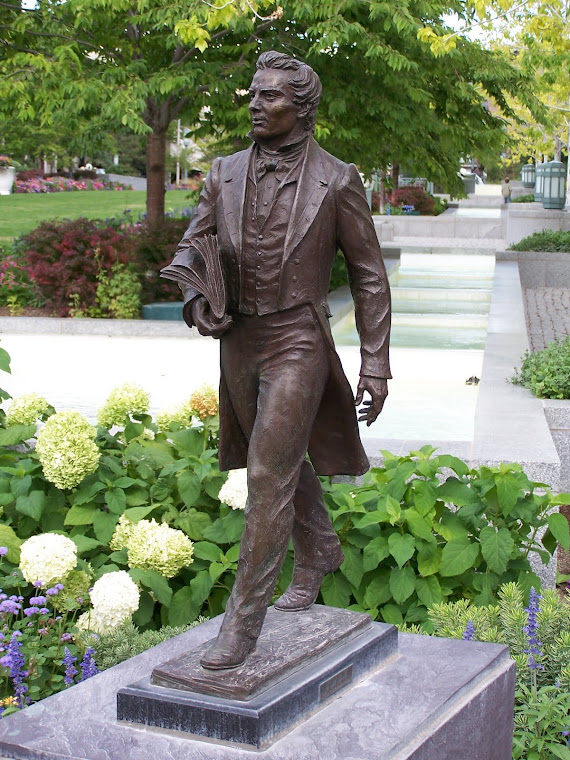
Joseph Smith

Joseph Smith
Prophet, Seer and Revelator
Showing posts with label Hard Work. Show all posts

Saturday, December 31, 2011

Family Farm

Both John's parents came from aristocratic families, but neither of them were the eldest so they didn't inherit land, titles or money. John's father worked in the British tax office.
Three years after their move to Liverpool, an uncle left James and Agnes a farm near Hale, so the family moved back to Westmorland. John continued his schooling in Beetham, walking about a mile each way.8 On the family farm John learned to plow, plant, harvest, stack hay, and do other chores. He loved to ride high-spirited horses, and was bucked off fairly often. “And I have indelibly impressed on my mind, some of my first mishaps in horsemanship . . . evolutions between the horses’ backs and terra firma (the ground).”
John learned to work hard. The Lord was preparing him for pioneer life to be able to survive in the Utah desert.

Saturday, January 22, 2011

Crossing the Wilderness

On the trail the pioneers found herds of buffalo. Brigham cautioned the men not to be wasteful, but to kill only as many animals as they could eat. They enjoyed the fresh meat and ate as much as they wanted, but those who ate too much had upset stomachs and digestive problems.


When the company reached the Platte River, the water ran high and swift. The animals swam across the river, and the men unloaded the wagons and carried their supplies to the other side in a leather boat they had with them. But getting the empty wagons across was more difficult. Brigham suggested they lash four wagons together and float them across with ropes tied to the wagon tongues to guide them from the other side. The river was so swift, it flipped the wagons over as if they were rolling logs. Next they built small rafts to ferry them across, but the rafts were swept away in the current. Brigham knew he could solve the problem so he took off his shirt and went to work. He and Willard Richards built a big, strong sturdy raft out of white pine and white cottonwood that carried the wagons safely across the river.

The company traveled over five-hundred miles in seven weeks, reaching Fort Laramie by the first of June. After they rested, the wagon train continued west. Jim Bridger, and explorer and mountain man of the American west, rode up to greet them one night when they were camped beside the Sweetwater River. He advised them not to go into the valley of the Great Salt Lake because crops wouldn’t grow there. He told Brigham that he would give a thousand dollars for a bushel of corn raised in the valley.

Brigham thanked Jim Bridger for his advice. But Brigham knew Heavenly Father wanted him to take the pioneers there, and he knew the Saints would survive. The corn and other crops would grow.

Saturday, January 15, 2011

A Daily Schedule

Here is a day in the life of the pioneers trecking west under the direction of Brigham Young. I don't know how long I'd last with a daily routine like this.

Each morning, the bugle sounded at five a.m. for everyone in the wagons to wake up and have prayers. Then they were to eat, feed their animals, and prepare to leave by seven a.m. They traveled all day long until the bugle sounded at eight thirty in the evening when everyone, dusty from the trail and weary from walking, was again to have prayer in their wagons and be in bed by nine o’clock.


If attacked by Indians, the wagons were to travel double file and pull into a circle with the wagon tongues on the outside and the animals inside the circle as they did every night. Along the way, Indians tried to steal their horses. A few times they were successful, to the irritation of Brigham. Guards were set to protect their animals.

At a distance, the Indians followed the movement of the pioneers from the time they left Winter Quarters. They burned the grassland ahead of the trail so there was no feed for the animals. The wind blew the ash from the fires across the prairie, stinging the pioneer’s eyes and throats and turning everyone black with soot until they could hardly recognize each other. ( And no washing machines to clean their clothes.)

I am grateful for my warm home and hot shower. Because of their efforts, I have a beautiful place to live and a testimony of the gospel.

Tuesday, November 2, 2010

Brigham's first job

Brigham left home when he was 16. He went to work as a carpenter, and his first task was to make a bed from an old, water-soaked log. An impossible task? He measured, sawed, hammered, scraped and notched until he had a beautiful bed frame.

He became a fine craftsman. Some of his furniture and mantle pieces are in museums in New England today.

Thursday, May 20, 2010

Brigham Young the Inventor

Did you know that Brigham Young worked for a shop that painted boats? It was a difficult task to crush the dye to color the paint so he invented a dye crusher. The shop owner thought it was a great invention.

Wednesday, May 12, 2010

Brigham Young in Person

Did you know that Brigham Young became very good at doing house work? Since his mother had tuberculosis, he learned to do dishes, clean the house, do the wash, make beds, make bread. When he was older he bragged that he could do housework as well as anyone.