On the trail the pioneers found herds of buffalo. Brigham cautioned the men not to be wasteful, but to kill only as many animals as they could eat. They enjoyed the fresh meat and ate as much as they wanted, but those who ate too much had upset stomachs and digestive problems.
When the company reached the Platte River, the water ran high and swift. The animals swam across the river, and the men unloaded the wagons and carried their supplies to the other side in a leather boat they had with them. But getting the empty wagons across was more difficult. Brigham suggested they lash four wagons together and float them across with ropes tied to the wagon tongues to guide them from the other side. The river was so swift, it flipped the wagons over as if they were rolling logs. Next they built small rafts to ferry them across, but the rafts were swept away in the current. Brigham knew he could solve the problem so he took off his shirt and went to work. He and Willard Richards built a big, strong sturdy raft out of white pine and white cottonwood that carried the wagons safely across the river.
The company traveled over five-hundred miles in seven weeks, reaching Fort Laramie by the first of June. After they rested, the wagon train continued west. Jim Bridger, and explorer and mountain man of the American west, rode up to greet them one night when they were camped beside the Sweetwater River. He advised them not to go into the valley of the Great Salt Lake because crops wouldn’t grow there. He told Brigham that he would give a thousand dollars for a bushel of corn raised in the valley.
Brigham thanked Jim Bridger for his advice. But Brigham knew Heavenly Father wanted him to take the pioneers there, and he knew the Saints would survive. The corn and other crops would grow.
Joseph Smith
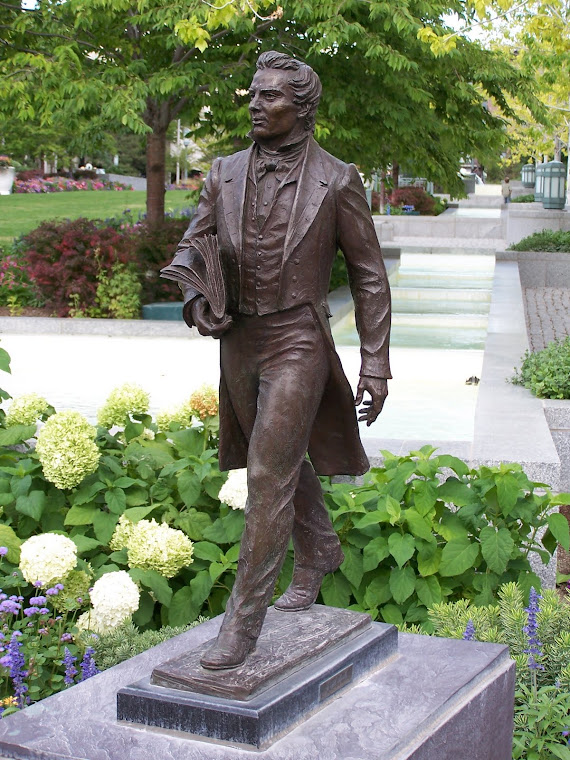
Prophet, Seer and Revelator
Saturday, January 22, 2011

Saturday, January 15, 2011
A Daily Schedule
Here is a day in the life of the pioneers trecking west under the direction of Brigham Young. I don't know how long I'd last with a daily routine like this.
Each morning, the bugle sounded at five a.m. for everyone in the wagons to wake up and have prayers. Then they were to eat, feed their animals, and prepare to leave by seven a.m. They traveled all day long until the bugle sounded at eight thirty in the evening when everyone, dusty from the trail and weary from walking, was again to have prayer in their wagons and be in bed by nine o’clock.
If attacked by Indians, the wagons were to travel double file and pull into a circle with the wagon tongues on the outside and the animals inside the circle as they did every night. Along the way, Indians tried to steal their horses. A few times they were successful, to the irritation of Brigham. Guards were set to protect their animals.
At a distance, the Indians followed the movement of the pioneers from the time they left Winter Quarters. They burned the grassland ahead of the trail so there was no feed for the animals. The wind blew the ash from the fires across the prairie, stinging the pioneer’s eyes and throats and turning everyone black with soot until they could hardly recognize each other. ( And no washing machines to clean their clothes.)
I am grateful for my warm home and hot shower. Because of their efforts, I have a beautiful place to live and a testimony of the gospel.
Saturday, January 8, 2011
Transfiguration of Brigham Young
After the death of the Prophet Joseph Smith, Brigham Young spoke to the Saints in Nauvoo in a meeting. As he spoke, Brother Benjamin F. Johnson, and many others, reported “as from Heaven, I heard the voice of the Prophet Joseph that thrilled my whole being and . . . I saw in the transfiguration of Brigham Young, the tall straight . . . form of the Prophet Joseph Smith clothed in a sheen of light covering him to his feet.” When Brigham addressed the Saints, he looked and sounded just like Joseph Smith, showing the people that the twelve apostles, with Brigham as president, were to lead the people.
Brigham knew he and the other apostles had to help the Church accomplish the purposes that Heavenly Father had revealed through Joseph Smith. Even though he was very sad that Joseph Smith was gone, he remembered the strength and power of Joseph the prophet. Brigham Young tried to follow Joseph’s example the rest of his life.
Brigham knew he and the other apostles had to help the Church accomplish the purposes that Heavenly Father had revealed through Joseph Smith. Even though he was very sad that Joseph Smith was gone, he remembered the strength and power of Joseph the prophet. Brigham Young tried to follow Joseph’s example the rest of his life.
Saturday, January 1, 2011
Appreciation for Life
Joseph F. Smith's first child, Mercy Josephine, died before her third birthday, he wrote: “My heart is bruised and wrenched almost asunder. I am desolate, my home seems desolate. … I look in vain, I listen, no sound, I wander through the rooms, all are vacant, lonely, desolate, deserted. … No beaming little black eyes sparkling with love for papa; … but a vacant little chair. … and only the one desolate thought forcing its crushing leaden weight upon my heart—she is not here, she is gone!”
As I read this quote, it made me appreciate the life and love of my children. How grateful I am for their lives and their light. Sometimes I take it forgranted, and I don 't ever want to do that.
Especially at this time of year I am grateful for the Savior and his Atonement that we may live again.
Saturday, December 18, 2010
Joseph's Message to Brigham Young
: “Tell the people to be humble and faithful and [be] sure to keep the Spirit of the Lord and it will lead them right. Be careful and not turn away the small still voice; it will teach [you what] to do and where to go; it will yield the fruits of the kingdom. Tell the brethren to keep their hearts open to conviction so that when the Holy Ghost comes to them, their hearts will be ready to receive it. They can tell the Spirit of the Lord from all other spirits. It will whisper peace and joy to their souls, and it will take malice, hatred, envying, strife, and all evil from their hearts; and their whole desire will be to do good, bring forth righteousness, and build up the kingdom of God. Tell the brethren if they will follow the Spirit of the Lord they will go right” (Teachings: Joseph Smith, 98).
Saturday, December 11, 2010
Joseph Smith appears to Brigham Young
Joseph Smith cared enough about us to come back and tell Brigham Young to keep us on the straight and narrow. I love learning about the Holy Ghost. It is the most wonderful gift in the world. I only hope I can live my life so I am worthy to receive this blessing.
Several years after the Prophet Joseph Smith was killed, he appeared to President Brigham Young and said: “Tell the people to . . . keep the Spirit of the Lord and it will lead them right. . . the small still voice . . . will teach [you what] to do and where to go; . . . Tell the brethren to keep their hearts open . . . so that when the Holy Ghost comes to them, their hearts will be ready to receive it. They can tell the Spirit of the Lord from all other spirits. It will whisper peace and joy to their souls, . . . and their whole desire will be to do good. . . if they will follow the Spirit of the Lord they will go right” (Teachings: Joseph Smith, 98).
Several years after the Prophet Joseph Smith was killed, he appeared to President Brigham Young and said: “Tell the people to . . . keep the Spirit of the Lord and it will lead them right. . . the small still voice . . . will teach [you what] to do and where to go; . . . Tell the brethren to keep their hearts open . . . so that when the Holy Ghost comes to them, their hearts will be ready to receive it. They can tell the Spirit of the Lord from all other spirits. It will whisper peace and joy to their souls, . . . and their whole desire will be to do good. . . if they will follow the Spirit of the Lord they will go right” (Teachings: Joseph Smith, 98).
Saturday, December 4, 2010
Brigham Young's Mission to England
After the Saints were driven out of Missouri and the Prophet Joseph was free from prison, Brigham was called on a mission to England in 1839. He and his family were living in an old army barracks in Montrose, Iowa, on the swampy banks of the Mississippi River. Many of the Mormons, including Brigham and Mary Ann, got sick with malaria. Brigham could hardly get out of bed. Even though he was ill, he knew he needed to begin his mission. He wanted to serve the Lord because he loved missionary work.
His sister Fanny told him to stay home until he felt better, but he said he was going even though he was unwell. He started out, crossing the Mississippi River, but only got as far as Heber C. Kimball’s house on the other side. Heber and his family were also sick. Brigham rested there for four days. Mary Ann (Brigham's wife) found out he was still close by and came across the river to see him. Brigham and Heber could hardly walk because of their sickness, but they knew they had to leave for England. They climbed into the open wagon box to start the trip. Their wives stood in the doorway, watching. Heber said as they rode off, “This is no way to leave. Let’s give them a cheer.” Heber and Brigham wobbled to their feet and raised their hats, shouting, “Hurrah for Israel.” Heavenly Father blessed them to get well, and they were on their way to a successful mission with others of the twelve apostles.
Brigham and the other apostles converted between seven and eight thousand people during the year they were in Great Britain. What far-reaching effects those missionaries have had when we consider the generations of Church members that have come from these baptisms, missionary work performed by their descendants and temple work completed by family members.
Subscribe to:
Posts (Atom)